
EPISODES / EP 04 ·
Five and Dime
Walmart · Sam Walton
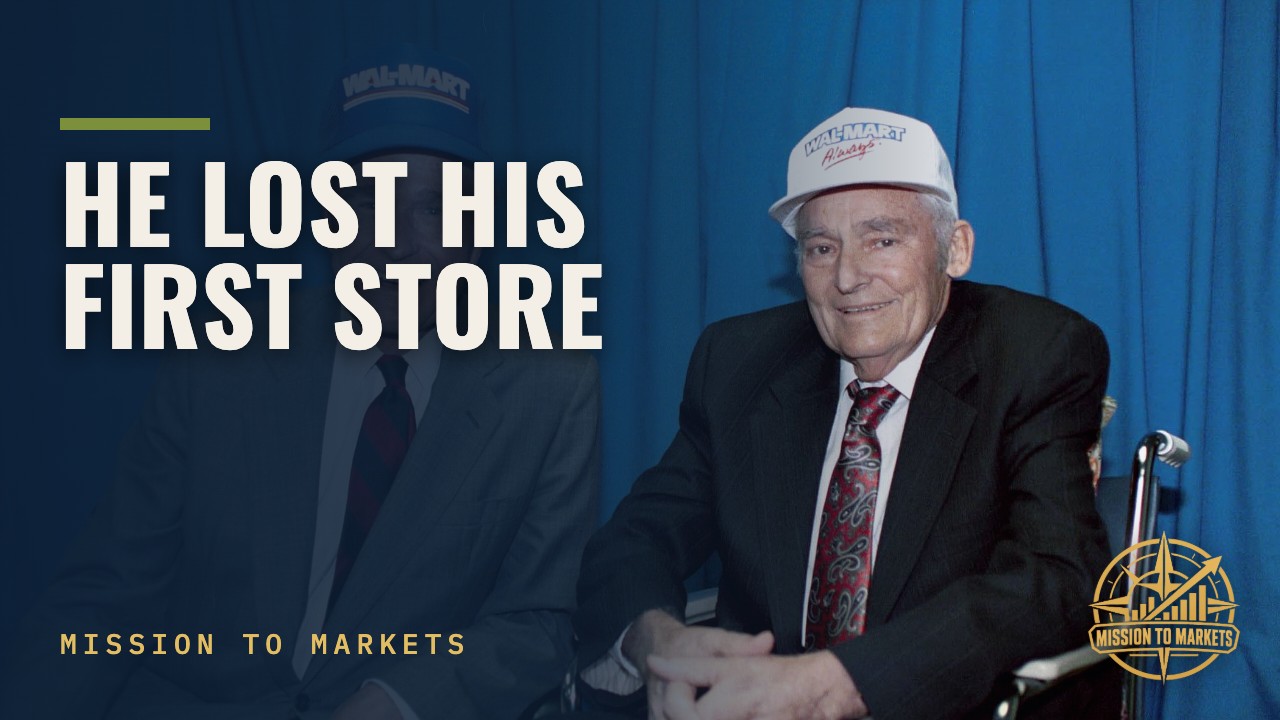
Sam Walton, an Army captain in WWII, built the best store in his region, lost it when the landlord wouldn't renew the lease, and started over in Bentonville.
SERVICE U.S. Army
Out now. About ten minutes.
THE LESSON / ED'S TAKE
If you've ever had a plan taken away for reasons you didn't control, Newport is your story too. The loss is real, and so is everything you learned before it. Take that with you.
In this episode
- 0:00Intro
- 1:04The Service
- 2:35The Problem
- 3:57The Plan
- 5:14The Stakes
- 6:43How It Turned Out
Read the full transcript
In three years, he took a small-town variety store from eighty thousand dollars a year in sales to two hundred twenty-five thousand. By 1950, it led its whole six-state region. He'd done everything right. Except read the lease closely. It had no option to renew. And when it ran out, the landlord wouldn't renew it. He gave the spot to his own son. So the young man sold out, packed up his family, and left town to start over in a place he barely knew. The young man was an Army veteran named Sam Walton. The place was Bentonville, Arkansas.
This is Mission to Markets, where every weekday we tell the true story of a company a veteran built. I'm Ed Parcaut. This episode is narrated with an AI version of my own voice, from a script I approved.
Why this show? I'm a Navy veteran who built businesses, and I kept finding out that companies I grew up with were built by people who'd served. Nobody tells you that part. So every weekday, we will.
The Service
Samuel Moore Walton finished college at the University of Missouri in 1940. Three days later, he went to work as a management trainee at a J.C. Penney store in Des Moines, Iowa, for eighty-five dollars a month. He liked retail right away. EBSCO notes he was influenced by the company's seven-point business philosophy. A written set of rules for how to run a store. Walton was taking notes.
Then came the war. Walton was inducted into the Army on July 16, 1942. He didn't go overseas. He spent the war stateside, much of it in Salt Lake City, Utah.
Now, the sources describe his assignment two different ways, and we're going to tell you both. The Encyclopedia of Arkansas says he served with Company A of the 777th Military Police Battalion. Other biographies, including the Horatio Alger Association's and EBSCO's, describe his work with the Army Intelligence Corps, supervising security at aircraft plants and prisoner-of-war camps. Those may well be two descriptions of the same job, but we couldn't confirm that, so you get both.
What the sources agree on: it was security work, behind the lines, guarding the places that built the planes and held enemy prisoners. And he rose to captain, which in the Army means you're responsible for a company-sized unit or a staff job with real weight. He was discharged in 1945.
During the war years, he met and married Helen Robson. She'd matter a great deal to what came next. So would her father.
The Problem
When Walton got out, he wanted his own store. A wholesale company called Butler Brothers offered him a franchise for one of its Ben Franklin variety stores in Newport, Arkansas. A franchise means you own and run the store, but under someone else's name and system, buying from them. The price was twenty-five thousand dollars. His father-in-law helped him buy it. Walton was twenty-seven years old.
He opened on September 1, 1945. And Newport was the classroom. A variety store, sometimes called a five-and-dime, sold a little of everything: thread, toys, kitchen stuff, candy. Walton's idea was about price.
He went looking for cheaper suppliers, sold for less, and made it up on volume. EBSCO describes it as profit on high sales, not high markups. It worked. Sales went from eighty thousand to two hundred twenty-five thousand in three years. By 1950, his store led Butler Brothers' six-state region in sales and profits.
That's when the landlord, a man EBSCO names as P.K. Holmes, refused to renew. The lease had no renewal option, and it charged rent at five percent of sales. Walton sold his inventory and fixtures to Holmes for fifty thousand dollars. And according to the Encyclopedia of Arkansas, the location went to the landlord's son.
The Plan
On May 1, 1950, the Waltons moved to Bentonville, a small town in the northwest corner of Arkansas. Within days, with his father-in-law's help again, he bought a variety store on the town square and reopened it as Walton's 5 and 10, with a one-day remodeling sale to get people in the door. The Encyclopedia of Arkansas says it was the third self-service variety store in the nation and the first in Arkansas. Self-service meant customers picked items off the shelves themselves and paid at the front, instead of asking a clerk to fetch everything.
That store is still there. Today it's part of the Walmart Museum.
Through the 1950s, he kept adding stores, in small towns across Arkansas, Missouri and Kansas. By 1962, EBSCO counts sixteen of them. But he was watching the bigger trend: discounting. Big, plain stores that sold brand-name goods cheap.
So Sam and his brother Bud raised the money and built one themselves, according to the State Historical Society of Missouri. On July 2, 1962, the first Wal-Mart Discount City opened in Rogers, Arkansas. Same year Kmart and Target were born, by the way. Walton was going up against companies with much deeper pockets, from a town most people had never heard of.
The Stakes
For the first years, Walmart was a side bet next to the Ben Franklin stores, and every new one was a risk. By January 1970, according to the Encyclopedia of Arkansas, the brothers had eighteen Walmarts and fourteen Ben Franklins.
That's the year Walmart went public, meaning it sold shares on the stock market so anyone could buy a piece of the company. It offered three hundred thousand shares, at sixteen dollars and fifty cents each, according to the company. That money paid for growth. By 1990, there were 1,573 stores and more than twenty-five billion dollars in sales. In 1991, Walmart became the largest retailer in the country.
Now, the fair part, and it's a big one. Walmart's growth came with hard criticism, and the sources don't hide it. The Encyclopedia of Arkansas notes that the company leaned heavily on part-time help, which cut out health benefits and overtime for a lot of workers. Some workers accused it of expecting work off the clock. It was sued over gender discrimination. Critics said it pushed suppliers toward overseas sweatshops to keep prices low. Labor groups went after its nonunion workforce. A 1995 study found that small businesses in towns with a Walmart saw sales drop by about a quarter over five years. Dozens of towns lobbied to keep it out. The same low prices that helped small-town shoppers hurt small-town stores. Both of those things are true.
How It Turned Out
Here's how it turned out. In 1983, the first Sam's Club opened, in Midwest City, Oklahoma. In January 1997, according to the Encyclopedia of Arkansas, Walmart's sales passed one hundred billion dollars. That's from one store in Rogers, thirty-five years earlier.
Walton didn't live to see that. In March 1992, President George H. W. Bush flew to Bentonville and gave Sam Walton the Presidential Medal of Freedom, the country's highest civilian honor. A few weeks later, on April 5, 1992, Walton died of cancer in Little Rock. EBSCO notes he was the richest person in the world at the time.
Three lessons, for you, if you're building something of your own.
One: read the lease. Walton built the best store in his region on property he didn't control, with no right to renew. You can do everything right and still lose it on paper. Know where you're exposed.
Two: losing isn't the end of the story. It's the middle. Newport taught him how to buy cheap and sell for less. The landlord could take the building. He couldn't take what Walton had learned in it. Walton just carried it to a new town and started again, five years older and a lot smarter. If you've lost something you built, that's worth sitting with.
Three: keep learning from everyone. His line, as the State Historical Society of Missouri records it: "You can learn from everybody." Competitors, clerks, customers, a landlord who wouldn't renew. The Army officer who'd guarded plants and prison camps took every one of those lessons and built the biggest retailer in the country, starting from a town square in Bentonville.
A young captain who lost his first real store, and refused to let it be his last.
If you've ever had a plan taken away for reasons you didn't control, Newport is your story too. The loss is real, and so is everything you learned before it. Take that with you.
Tomorrow: a Marine who served in the South Pacific comes home, opens a hot-dog stand, and ends up building Taco Bell. Because the mission didn't end when the uniform came off. New story every weekday. Subscribe so it's waiting for you. This is Mission to Markets, supported by my company, Parcaut Supply Co. I'm Ed Parcaut. Make it a great day.