
EPISODES / EP 05 ·
Third Time's the Bell
Taco Bell · Glen Bell
A Marine who served food in the South Pacific came home, learned tacos from the restaurant across the street, and built two taco chains before the one with his name on it.
SERVICE U.S. Marine Corps
Out now. About ten minutes.
THE LESSON / ED'S TAKE
If you've had to walk away from something you built, that might not be the end of the story. It might be the training.
In this episode
- 0:00Intro
- 1:04The Marine in the Mess
- 2:39The Stand Across the Street
- 4:08Make It Fast
- 5:57Starting Over Twice
- 7:21Third Time's the Bell
Read the full transcript
By 1962, Glen Bell was thirty-eight years old, and he'd already walked away from two taco chains. He built the first one with a partner, then sold his share when the partner didn't want to grow. He built the second with new partners. It made money. He sold out of that one too. Most people would take that as a sign to quit. Bell took it as practice. That year he opened a small stand on Firestone Boulevard in Downey, California, and finally put his own name on the sign. Taco Bell. And long before any of it, he'd served in the Pacific as a United States Marine.
This is Mission to Markets, where every weekday we tell the true story of a company a veteran built. I'm Ed Parcaut. This episode is narrated with an AI version of my own voice, from a script I approved.
Why this show? I'm a Navy veteran who built businesses, and I kept finding out that companies I grew up with were built by people who'd served. Nobody tells you that part. So every weekday, we will.
The Marine in the Mess
Glen Bell Jr. was born September 3rd, 1923, in Lynwood, California, according to the Downey Patriot. He grew up during the Great Depression. Military.com says his first taste of the food business was a short venture with his aunt, selling pies and other comfort food.
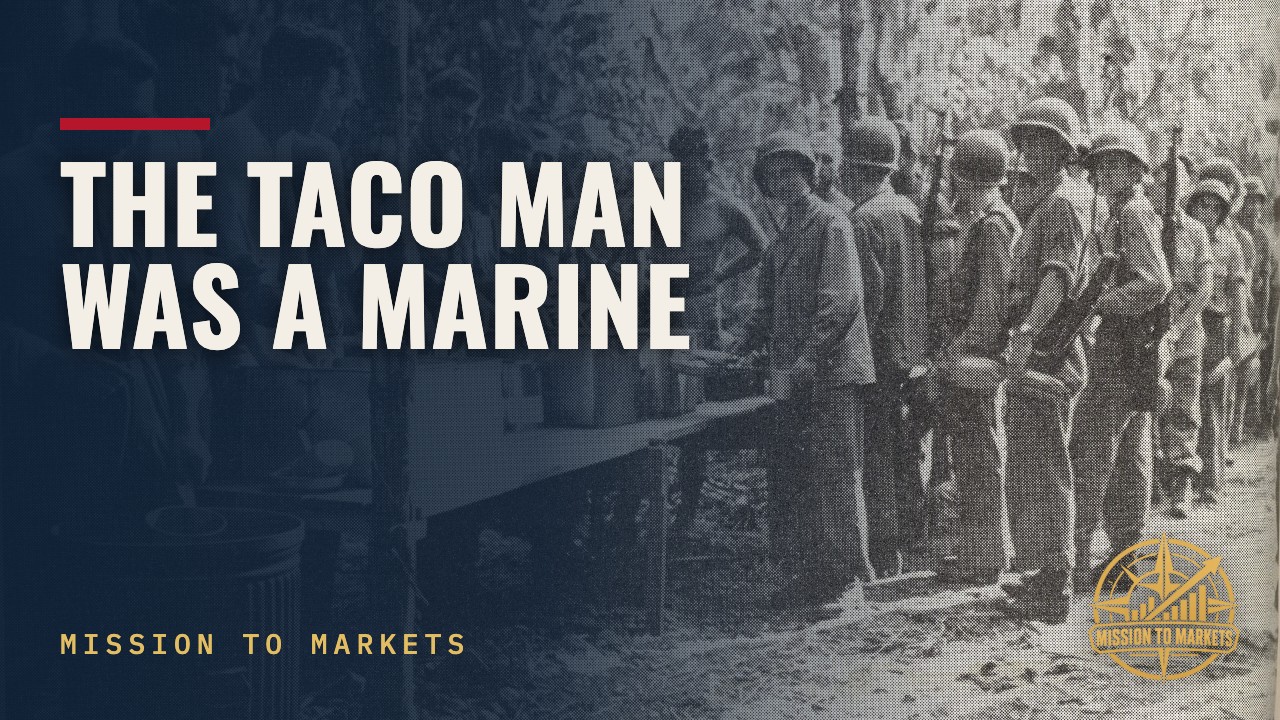
In 1943, he joined the Marine Corps. Taco Bell's own history says he served three years in the South Pacific and was honorably discharged in 1946. His obituaries, in the Downey Patriot and on NBC Los Angeles, say his unit fought at Guadalcanal and Guam. Guadalcanal was the first big American offensive of the Pacific war, a long, ugly fight over an airfield in the Solomon Islands, and it was ending as he enlisted. Guam was an American island the Japanese had seized. Marines took it back in the summer of 1944.
Here's the part that matters for this story. Bell's job, as far as the sources show, was food. Taco Bell's history says he started as a food server. Military.com says he spent much of the war cooking for high-ranking Army and Navy officers in the Solomon Islands.
I want to be careful here. No source I found says the mess hall gave him the idea for Taco Bell. But think about what that job is. You feed a lot of people, on a schedule, with whatever you've got, and nobody wants to hear excuses. That's a restaurant. It just has worse weather.
In 1946 he came home to Southern California. And a few years later, he watched two brothers in San Bernardino change the way America ate.
The Stand Across the Street
The brothers were Dick and Mac McDonald. Their idea was simple: fast, cheap food, handed out a window to people in cars. Southern California ran on cars. In 1948, according to the Associated Press, Bell opened Bell's Drive-In in San Bernardino, selling hamburgers and hot dogs through drive-in windows. The AP says he did it after seeing McDonald's succeed.
Here was his problem. Everybody could sell a hamburger. If Bell stayed a burger guy, he'd be competing with the best burger operation around, and he'd always be second.
So he looked across the street. Military.com says his stand sat across from the Mitla Cafe, a Mexican family restaurant on old Route 66 that NPR says had been serving since 1937. Mitla made crispy tacos stuffed with ground beef, lettuce and cheese.
In 2012, Mitla's owner, Irene Montaño, told NPR that Bell used to come over and, in her words, "talk to my father-in-law and ask him how to make tacos." Military.com says that's where he learned the hard-shell taco.
Now, the fair part. Glen Bell did not invent the crispy taco. Mexican and Mexican American cooks were making them long before he crossed that street, and Military.com says plainly that he didn't invent the hard-shell taco. What Bell saw was a different problem. A taco made the slow way, one at a time, couldn't be sold like a hamburger. And in that business, fast was the whole game.
Make It Fast
Bell's plan was to make the taco work like a hamburger. Military.com credits him with a way to pre-make hard taco shells in big batches, faster and with less mess. Taco Bell's own history says he tuned the assembly line until a taco went from the kitchen to the first bite within minutes.
According to Military.com, citing a 1999 biography, he added tacos to the menu at his burger stand in 1951, at nineteen cents each. Taco Bell's own history ties the nineteen-cent taco to his first taco stand instead. Either way, the price was the pitch.
Then he did the hard thing. He started over.
In 1954, he and a partner opened Taco Tia, a set of drive-thru taco stands in Southern California. They built three. The Downey Patriot says the partner didn't want to expand, so Bell sold his interest.
In 1958, with new partners, he opened El Taco in the Long Beach area. The Downey Patriot says it grew across California and was very profitable. Bell sold his shares anyway. He wanted something that was his.
He even helped start a hot dog chain along the way. In 1961, with one of his crew, a young man named John Galardi, he started Der Wienerschnitzel. Galardi grew it into its own national chain.
And in 1962, Bell opened the first Taco Bell, on Firestone Boulevard in Downey. Military.com says he did it with just four thousand dollars. More small stores followed in Long Beach, Paramount and around Los Angeles.
In 1964 he sold his first franchise. A franchise is when another owner pays you for the right to run a store under your name, using your system. It's how one stand becomes a chain without you building every store yourself.
Starting Over Twice
Look at that timeline from Bell's side. By the time he opened Taco Bell, he'd been in the food business for fourteen years. He'd built a burger stand, a taco chain, a second taco chain, and part of a hot dog chain. Twice he'd sold his stake and walked away from something that was working.
That's not a straight line. That's a man betting his own money that he was right about where the business should go, and his partners were wrong.
Every time he sold out, he started from zero. New locations, new money, new crew. And the people he trained kept going without him. Der Wienerschnitzel became Galardi's. The Downey Patriot says another of Bell's people left to open a drive-in that became Del Taco.
He wrote the playbook, and other people ran it against him.
Taco Bell itself was a bet, too. In NPR's 2012 story, food historian Jeffrey Pilcher credits Bell with franchising Mexican food and selling it to a mainstream audience in California in the 1950s and '60s. That audience had to be built, one cheap taco at a time.
So Bell put on a show. The company's own history says his grand openings were compared to a World's Fair, with spotlights, bands, dancers and free hats. That isn't vanity. When people don't know what you sell, you have to give them a reason to show up once. After that, the food has to bring them back.
Third Time's the Bell
It brought them back. By 1978, there were eight hundred sixty-eight Taco Bell restaurants. That year, Bell sold them to PepsiCo for one hundred twenty-five million dollars in stock, according to the Associated Press. In stock means he was paid in shares of PepsiCo, not a check. Nation's Restaurant News put the deal at one hundred thirty million, so the exact figure depends on who you ask.
Bell made Rancho Santa Fe his home. The Downey Patriot says he built Bell Gardens, a hundred-fifteen-acre farm and park in San Diego County, open to the public, that taught people about agriculture. He died in January 2010, at eighty-six. Today, according to the company, Taco Bell has more than seven thousand restaurants.
Three lessons.
One. You don't have to be first. You have to be fast. Bell didn't invent the taco, and he didn't invent the drive-in. He put two things that already worked together, at a price almost anyone could pay.
Two. Pick your partners like the company's life depends on it, because it does. Twice Bell walked away because his partners wanted something different. It cost him years. It also taught him exactly what he needed: control of his own thing.
Three. Give credit where it's due. The taco that built this empire came from a family kitchen across the street, and Mitla Cafe was still serving it when NPR stopped by in 2012. When you build on somebody else's idea, say so. It doesn't make you smaller.
Here's my take, for you, building something of your own. Glen Bell served food to officers in the South Pacific, came home, and started over again and again for fourteen years before the name on the sign was his. If you've had to walk away from something you built, that might not be the end of the story. It might be the training.
Tomorrow: two Stanford friends, a rented garage, and an Army call-up that came just as their company got going. Because the mission didn't end when the uniform came off. New story every weekday. Subscribe so it's waiting for you. This is Mission to Markets, supported by my company, Parcaut Supply Co. I'm Ed Parcaut. Make it a great day.