
EPISODES / EP 06 ·
Called Up
Hewlett-Packard · Bill Hewlett
Hewlett-Packard was a two-year-old garage startup when the Army called Bill Hewlett to active duty, and his partner kept it alive.
SERVICE U.S. Army Signal Corps
Out now. About ten minutes.
THE LESSON / ED'S TAKE
If life pulls you away from what you're building, that doesn't have to be the end of it. Pick your partner well, and leave the light on.
In this episode
- 0:00Intro
- 1:02The Officer From the Garage
- 2:49A Market for This Thing
- 4:07Five Hundred Thirty-Eight Dollars
- 5:41One Founder at War
- 7:32The HP Way
Read the full transcript
In the spring of 1941, Hewlett-Packard was barely two years old. It had started in a garage in Palo Alto, California, with five hundred thirty-eight dollars and a used drill press. Its first real product was an audio oscillator that Bill Hewlett designed, and Walt Disney's studio had bought eight. Business was finally moving. Then the Army called. Hewlett had taken ROTC at Stanford, so he held a reserve officer's commission, and now he was ordered to active duty. One founder went to war. The other stayed behind to keep a tiny company alive.
This is Mission to Markets, where every weekday we tell the true story of a company a veteran built. I'm Ed Parcaut. This episode is narrated with an AI version of my own voice, from a script I approved.
Why this show? I'm a Navy veteran who built businesses, and I kept finding out that companies I grew up with were built by people who'd served. Nobody tells you that part. So every weekday, we will.
The Officer From the Garage
William Redington Hewlett was born May 20th, 1913, in Ann Arbor, Michigan, according to his National Academy of Sciences memoir.
At Stanford, Hewlett took ROTC. That's the Reserve Officers' Training Corps, a college program that trains students to become military officers. In a 1984 oral history for the IEEE, the big engineering society, Hewlett said he was commissioned in Ordnance, which he called "the engineering side of the army."
In the spring of 1941, months before Pearl Harbor, the paper turned real. He was called to active duty. His National Academy memoir says the Army first put him in aviation ordnance, which made poor use of his skills. So his partner went to work. Packard wrote to Colonel Roger Colton of the Signal Corps and argued for a transfer. The Signal Corps is the Army branch that handles communications: radio, radar, the electronics that let an army talk to itself. Hewlett moved to the Signal Corps at Fort Monmouth, New Jersey.
Hewlett told the IEEE he reported there in July 1941, and in September he was released as an essential employee of his own company. After Pearl Harbor, he was called back, this time to Washington.
For most of the war he worked in the office of the Chief Signal Officer, the Army's top communications command. By his own account, he ended up responsible for new products introduction, which he called "kind of a staff job." Near the end of the war he went to the Philippines. And around the Japanese surrender, he joined an intelligence mission run by the physicist Karl Compton, to take a quick look at what Japan had been doing in electronics.
He left the Army a lieutenant colonel, according to both his National Academy of Sciences memoir and his National Academy of Engineering tribute.
A Market for This Thing
Rewind to 1934. Hewlett and David Packard graduated from Stanford as electrical engineers. HP's own history says they went on a two-week camping and fishing trip in the Colorado mountains and came back close friends. Packard took a job at General Electric in Schenectady, New York, in vacuum tube engineering. Hewlett went on to graduate school at MIT and Stanford. Their Stanford professor, Fred Terman, kept nudging them to start a business together.
The country was still in the Great Depression. Leaving a steady job at GE to build something in a garage was a real risk.
So what did they see? Hewlett had been studying negative feedback, a way of feeding part of a circuit's output back in to keep the circuit steady. According to HP, that work led to a new kind of audio oscillator. An audio oscillator is a box that makes a clean, steady tone at whatever pitch you dial in. Sound engineers use it to test amplifiers, speakers and recording gear. Hewlett's trick was a small light bulb inside the circuit, which kept the tone stable.
In the IEEE interview, he described the start-up logic simply. They said, in his words, "Well, maybe there's a market for this thing."
That was it. Not a fifty-page business plan. A circuit, a friend, and a hunch.
Five Hundred Thirty-Eight Dollars
The plan was to start small and stay alive. In 1938, according to HP, Dave and his wife Lucile moved into the first-floor flat of a house at 367 Addison Avenue in Palo Alto. Bill rented the shed out back. The garage became the workshop. Total working capital: five hundred thirty-eight dollars, which HP says included a used Sears-Roebuck drill press.
On January 1st, 1939, they made the partnership official. HP says they decided the company's name with a coin toss, and Hewlett's name ended up first.
Their first product was the Model 200A. Why 200? HP quotes Packard saying they thought the name "would make us look like we'd been around for awhile." Two guys in a garage, picking a model number to look bigger. Every founder listening knows that move.
Then came the order that put them on the map. Walt Disney's studio was getting ready to release Fantasia, with a new kind of multi-channel sound. HP says Disney asked for changes, HP built a modified version called the 200B, and Disney ordered eight.
They took any work they could find. Hewlett's National Academy memoir quotes him: "In the beginning we did anything to bring in a nickel."
HP's timeline says 1939 revenue was five thousand three hundred sixty-nine dollars, with two people. In 1940 they moved out of the garage into rented space in Palo Alto. In 1941, revenue passed one hundred six thousand dollars. It was working. And that was the year the Army called.
One Founder at War
Picture the company in 1941. Two founders. One designs the products. The other runs the business. Then the designer is gone.
Packard ran HP alone. And this is where his character shows. Hewlett's National Academy memoir says Packard kept his own salary below what Hewlett was earning in the Army, because he thought it was unfair to earn more at home than his friend did at war.
Was Packard a veteran too? As far as the sources show, no. He didn't serve in uniform. He stayed home and ran the company. Decades later he did serve at the Pentagon, as a civilian, when President Nixon made him Deputy Secretary of Defense in 1969.
The war turned a trickle of government orders into a flood, in HP's own telling. HP built signal generators for the Naval Research Laboratory, and a radar-jamming device. Radar jamming means sending out signals that blind the enemy's radar. Revenue went from about one hundred six thousand dollars in 1941 to nine hundred fifty-three thousand in 1943, according to HP's timeline. Hewlett later told the IEEE that HP had seventeen people when he left, and, in his words, "at the end of the war we had two hundred."
Growth like that is its own danger. When a war ends, the war orders stop. According to the IEEE Computer Society's biography of Packard, business fell off sharply after the war, and HP had to lay people off, the only time that happened in Packard's career.
There's also a timing question in the record. Hewlett's memoir says he came back to Palo Alto in 1945. HP's own timeline says he served as an Army officer until 1947. Either way, he came home to a company that had grown up without him, and was about to shrink.
The HP Way
They got through it. HP incorporated on August 18th, 1947, according to the company, with Packard as president and Hewlett as vice president.
From there, HP grew from test instruments into computers and printers. Along the way the founders built a culture people later called the HP Way: first names for everyone, open offices without doors, profit-sharing, and, in 1942, a companywide catastrophic health insurance plan, which HP says was almost unheard of at the time.
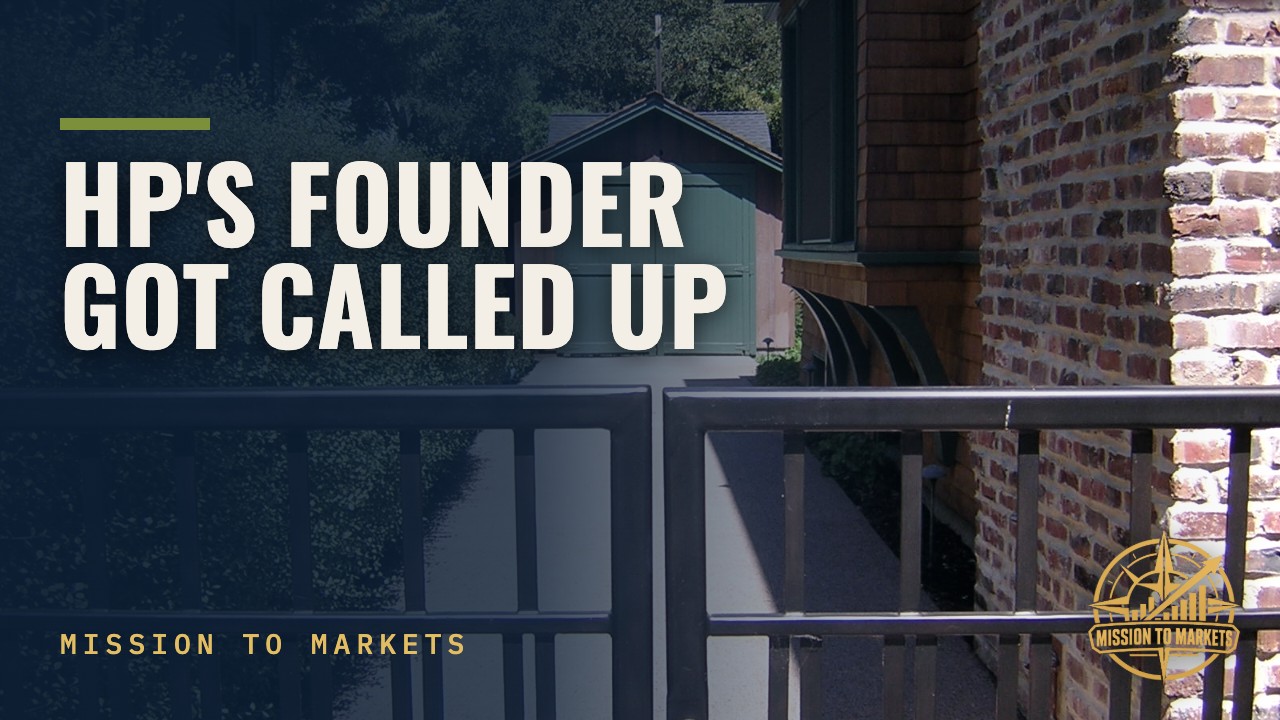
The garage at 367 Addison Avenue is now California Historical Landmark number 976, the Birthplace of Silicon Valley. Hewlett and his wife Flora started the William and Flora Hewlett Foundation in 1966. He died in Palo Alto on January 12th, 2001, at eighty-seven.
Bill Hewlett's story didn't quite end with him. In 2002, HP's CEO, Carly Fiorina, pushed to merge with Compaq, another computer maker. Bill's son Walter, an HP director, led a shareholder fight against it, and the Hewlett and Packard families and foundations voted no. The merger passed by what a Delaware judge called a slim but sufficient margin. Walter sued, lost in court, and let it go.
Three lessons.
One. Your company has to survive you being gone. Hewlett was away for years, and HP grew anyway, because Packard could run it and the product was good. Build something that doesn't need you in the room every day.
Two. Take care of the partner who's carrying the load somewhere else. Packard wrote the letter that got Hewlett out of a job that wasted him, and he kept his own pay under his friend's Army pay. That's how a partnership lasts half a century.
Three. Boom times hide busts. War orders made HP big fast, and when they stopped, HP had to cut. If one big customer is most of your business, plan for the day it leaves.
Here's my take, for you, building something of your own. Bill Hewlett didn't found HP after the war. He founded it before, then answered the call with his company two years old. If life pulls you away from what you're building, that doesn't have to be the end of it. Pick your partner well, and leave the light on.
Tomorrow: an Army drill sergeant, twelve hundred dollars, and three years of selling T-shirts out of his car. Because the mission didn't end when the uniform came off. New story every weekday. Subscribe so it's waiting for you. This is Mission to Markets, supported by my company, Parcaut Supply Co. I'm Ed Parcaut. Make it a great day.