
EPISODES / EP 03 ·
Wingman
Enterprise Rent-A-Car · Jack Taylor
A Navy Hellcat pilot started a leasing company with seven cars, then named it after an aircraft carrier he barely served on.
SERVICE U.S. Navy
Out now. About ten minutes.
THE LESSON / ED'S TAKE
You don't have to be the ace to build something big. Most of us in uniform were wingmen, and covering the people beside you is exactly what a growing company needs.
In this episode
- 0:00Intro
- 1:03The Service
- 3:01The Problem
- 4:01The Plan
- 5:03The Stakes
- 6:27How It Turned Out
Read the full transcript
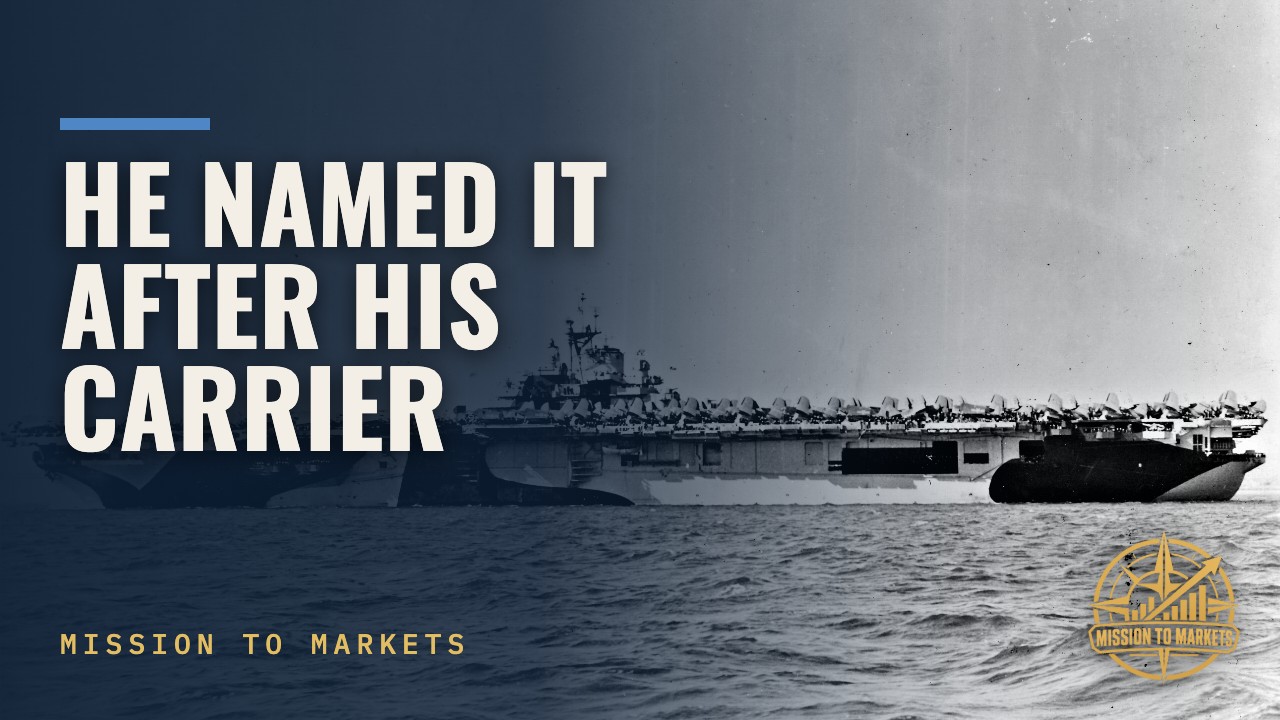
In 1969, a car leasing company in St. Louis needed a new name. It wanted to open in Atlanta, and somebody there already had the old one. The founder had flown Hellcat fighters off two aircraft carriers in World War II. He spent most of his time on the USS Essex. But Essex, he said later, is "kind of a ponderous name." The other ship was the USS Enterprise. His son would put it plainly years later: "He spent more time on Essex, but Enterprise is a better name for a rental car company." That's how you got Enterprise Rent-A-Car.
This is Mission to Markets, where every weekday we tell the true story of a company a veteran built. I'm Ed Parcaut. This episode is narrated with an AI version of my own voice, from a script I approved.
Why this show? I'm a Navy veteran who built businesses, and I kept finding out that companies I grew up with were built by people who'd served. Nobody tells you that part. So every weekday, we will.
The Service
Jack Crawford Taylor was born in St. Louis in 1922. He was a student at Washington University when Pearl Harbor was attacked. He left school and went to war. By his own account, he tried the Army Air Corps first, then came into the Navy's flight program for aviation cadets.
He earned his wings and was picked to fly the F6F Hellcat. That was the Navy's front-line fighter, a big, tough, single-engine plane built to fly off a carrier deck. In June 1944, Ensign Taylor joined Fighting Squadron Fifteen aboard the USS Essex as a replacement pilot. An ensign is the Navy's lowest officer rank. A replacement pilot fills a seat in a squadron that's already been fighting.
Carrier Air Group Fifteen became one of the most decorated outfits in Navy aviation history. Its commander, David McCampbell, was the Navy's top ace of the war. Taylor flew as his wingman on several missions. A wingman's job isn't glory. It's watching your leader's back so he can press the attack. Taylor was credited with two enemy planes, so he wasn't an ace. The Naval Historical Foundation says his role still mattered, because he flew on the wing of the men who were.
In the fall of 1944, during the fight for the Philippines, his group found the Japanese battleship Musashi, one of the largest warships ever built. Taylor went in nearly straight down, strafing to knock out the anti-aircraft guns so the torpedo planes could get through. Then his section leader took them back in for a second run. Taylor remembered it in his oral history: going back a second time, he said, "frankly scared the hell out of me." The Musashi sank.
Later, when Essex pulled back to rearm, Taylor and some other pilots were sent over to the Enterprise, which was short of pilots and planes as the kamikaze threat grew. He came home with two Distinguished Flying Crosses and the Air Medal. His fighter squadron, he said, lost about half its pilots.
The Problem
After the war, Taylor started a delivery business in Clayton, Missouri. One truck turned into four. Then, in 1948, he gave it up to sell Cadillacs for a dealer named Arthur Lindburg.
Selling cars, he noticed something. Plenty of people wanted the car without the commitment of buying one. Leasing was new and growing. That's when a company owns the car and you pay to use it for a set time. And he noticed another group nobody was serving well: people whose own car was stuck in the shop. The big rental companies lived at airports. They were built for business travelers flying in. If your car was in the body shop across town, you were on your own.
In 1957, Taylor asked Lindburg if he could start a leasing business at the dealership. Lindburg agreed. Taylor later said of that leap: "somehow the risk of starting up my own company didn't seem all that big a deal." When you've dived on a battleship, a car lease probably feels manageable.
The Plan
Executive Leasing opened in the lower level of the dealership, with seven cars. That's it. Seven.
In 1962, it added rentals, mostly as a service for leasing customers who needed a loaner. The rental fleet was seventeen cars. A company history says Taylor never did learn why it was seventeen.
Then a manager named Don Holtzman found the niche, according to that same history: insurance adjusters. When a customer's car was wrecked or stolen, the insurance company needed a replacement car, cheap and close by. Enterprise could undercut the airport giants because it wasn't paying airport rent. It put its branches in neighborhoods, where people actually lived and worked.
In 1969, Taylor took the company beyond St. Louis, and that's when the name changed. In his own words, "Enterprise" had "an upbeat, go-go, positive image." He kept the "E" logo he already had. And he gave the company a little piece of the war: a carrier that had fought through nearly the whole war.
The Stakes
Enterprise doesn't have a dramatic near-death story, and that's worth saying out loud. It grew slowly, on purpose, for a long time. In 1980, according to the company, the fleet hit six thousand vehicles. Twenty-three years in, that's not a rocket ship.
It wasn't easy, either. According to the International Directory of Company Histories, the 1974 energy crisis briefly slowed the rental expansion. In the 1980s, the big names noticed the neighborhood business. Hertz moved in, then pulled back out by the end of the decade. National struggled. Enterprise had something they didn't: a decade and more of knowing that customer.
And it had a way of growing people. The company promoted its managers from within, and later paced its expansion by how many managers were ready. That's a Navy idea, if you think about it. You don't send a ship out without a crew that's qualified to run it.
There's a fair criticism here too. That culture of long hours has drawn lawsuits. In 2013, Enterprise agreed to a $7.8 million settlement with former assistant managers who said they'd been wrongly denied overtime pay, and similar suits have followed. In 2002, it settled a class-action discrimination case for $2.3 million. Growing from within only works if the people inside are treated right.
How It Turned Out
Here's how it turned out. In 1989, Enterprise Leasing became Enterprise Rent-A-Car, with more than five hundred locations and over fifty thousand rental cars, according to the company. Its free pick-up service became the slogan everybody knows: "We'll pick you up." It finally opened its first airport location in 1995. In 2007, it bought Alamo and National. By 2022, the company says, it had about thirty billion dollars in annual revenue and more than two million vehicles. It's still private.
Jack Taylor stepped down as CEO in 1991, and his son Andy ran it. Then, for a stretch, someone outside the family did: Pam Nicholson, CEO from 2013. In 2020, Jack's granddaughter Chrissy Taylor took over. According to Auto Remarketing, she's only the fourth CEO in the company's history.
Jack gave away more than eight hundred sixty million dollars of his own money starting in 1982. He died in St. Louis in July 2016, at ninety-four.
Near the end of his oral history, he was asked if he had any final thoughts. He said, "I look upon my Naval experience as one of the best things that have happened in my life." And then, quietly, he added, other than the fact that a lot of his buddies got killed.
Three lessons, for you, if you're building something of your own.
One: look where the giants aren't. Hertz and Avis fought over airports. Taylor took the body shop across town. The customer nobody wanted became the whole business.
Two: seven cars is enough to start. You don't need a fleet. You need a desk, a real customer, and patience.
Three: be a wingman. Taylor wasn't the ace. He was the guy who made sure the aces came home. He built a company the same way, by growing people who could lead the next branch.
An ensign who flew on the wing of the Navy's best, and named his company after a ship he served on for only a short time. Good name, though.
You don't have to be the ace to build something big. Most of us in uniform were wingmen, and covering the people beside you is exactly what a growing company needs.
Monday: an Army officer builds the best store in his region, loses the lease, and has to start over. The second try becomes Walmart. Because the mission didn't end when the uniform came off. New story every weekday. Subscribe so it's waiting for you. This is Mission to Markets, supported by my company, Parcaut Supply Co. I'm Ed Parcaut. Make it a great day.