
EPISODES / EP 02 ·
Business, Not Bullets
Combat Flip Flops · Matthew Griffin & Donald Lee
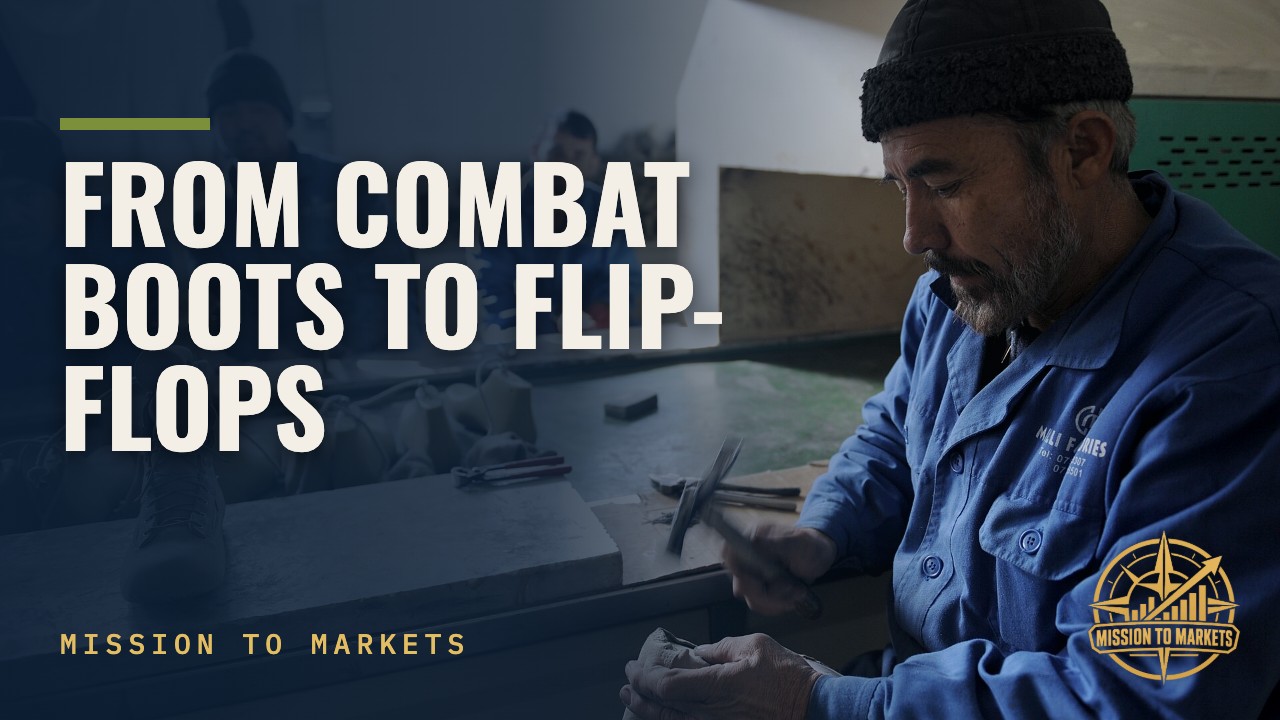
Two Army Rangers saw a flip-flop made from a combat boot in Kabul and built a company on one idea: businesses are better than bullets.
SERVICE U.S. Army (75th Ranger Regiment)
Out now. About ten minutes.
THE LESSON / ED'S TAKE
A lot of veterans come home wanting the work to still mean something. Griff and Donald showed you don't have to choose between a mission and a business. Build it right, and the business is the mission.
In this episode
- 0:00Intro
- 1:04The Service
- 2:30The Problem
- 3:45The Plan
- 5:01The Stakes
- 6:23How It Turned Out
Read the full transcript
Four thousand people had already paid for flip-flops. The factory in Kabul that was supposed to make them got notice it was closing. The pairs it did finish were defective, every one, according to Foreign Policy. A second Kabul factory shut down before it delivered a single order. So by the winter of 2012, an Army Ranger veteran had a pile of raw materials, a stack of customer orders, and nowhere to make anything. Except his garage, outside Seattle. That's where Combat Flip Flops was really born: on a personal credit card, working from five in the morning to midnight.
This is Mission to Markets, where every weekday we tell the true story of a company a veteran built. I'm Ed Parcaut. This episode is narrated with an AI version of my own voice, from a script I approved.
Why this show? I'm a Navy veteran who built businesses, and I kept finding out that companies I grew up with were built by people who'd served. Nobody tells you that part. So every weekday, we will.
The Service
Matthew Griffin goes by Griff. According to his company and to Military.com, he's a West Point graduate. And according to the Army's own reporting, he served about five years, with the Second Battalion, Seventy-Fifth Ranger Regiment, at what's now Joint Base Lewis-McChord in Washington State.
The Rangers are the Army's elite light infantry. They're the people sent on raids, at night, when it has to go right the first time. Griff did three tours in Afghanistan and one in Iraq. His job was fire support officer for a rifle company. That means when the Rangers on the ground needed artillery, mortars or aircraft, he was the one coordinating it, so the rounds landed on the enemy and not on his own guys. If you caught yesterday's episode, it's a close cousin of what Fred Smith did over Vietnam as a forward air controller. Two generations apart, same job at heart: get the right thing to the right place, on time, under pressure.
His partner, Donald Lee, served in the same battalion. The company says he joined the Army in 2002 and did three combat tours as an airborne Ranger. Before the Army, Lee was an online marketing guy. Keep that in mind. It matters later.
Griff left the Army in 2006. And then, like a lot of veterans, he went back. He took a job that sent him to Afghanistan to help manage medical supplies, and his work supported the Afghan National Army's combat medic program.
The Problem
In 2009, on one of those trips, Griff walked through a combat boot factory in Kabul that made boots for Afghan soldiers. And on a table, he saw something strange: a combat boot sole, with a flip-flop strap punched right through it.
The workers had made it for soldiers in garrison. Devout Muslims pray five times a day and take off their shoes to do it. Laced boots are slow. A sandal on a boot sole was quick, and it lasted. Griff told Foreign Policy it was, quote, "the ugliest and coolest thing I've ever seen."
But the problem he saw wasn't footwear. It was jobs. He'd seen what war-torn places go without: medicine, schools, clean water, electricity. Military.com puts his view simply: that kind of scarcity makes it easier for radical groups to recruit. He went home and registered the web address that same night, according to Amazon's profile of the company.
So the idea was this: build real products in conflict zones, sell them to Americans, and let the factory jobs do something the military couldn't. Griff boiled it down on Shark Tank years later. Quote: "businesses are better than bullets." The company slogan is shorter: Business, Not Bullets.
The Plan
Griff and Lee started the company in Washington State. Most accounts say 2011. One says 2012. Griff's brother-in-law, Andy Sewrey, came on soon after, and later coverage counts him as a co-founder too.
There was no investor. They put in their own money and sold off personal stuff to raise more. Griff's line to Foreign Policy: "If it had value, we sold it."
The plan was to make the sandals at a factory in Kabul and sell them online. That's where Lee's marketing background came in. Today his title is chief marketing officer, and his specialty, per the company, is finding customers online and turning them into buyers. By March 2012, according to Foreign Policy, they had about four thousand preorders.
Then the ground shifted. In June 2011, the U.S. had announced it would start pulling troops out of Afghanistan. Aid money started leaving with them. That Kabul factory employed more than three hundred people, according to Foreign Policy. In May 2012, it got notice it would close, as the program that bought from Afghan suppliers wound down. That's the cold open. The first batch was bad. The backup factory folded. And the guys who'd sold customers on a mission had a garage in Issaquah, Washington, and a team of family and friends.
The Stakes
For four months, that garage was the factory. Family and friends worked from five a.m. to midnight. The Army's article says about four thousand pairs came out of that garage. It was all on Griff's personal credit card. If you ever wondered what "bootstrapping" means, it's that, with actual boots.
They knew it couldn't last. In February 2013, at a big apparel trade show in Las Vegas, they found a partner that represented factories in Colombia, a country rebuilding after its own long war. In August 2013, the Colombian factory delivered their first good order, and the last of those preorders finally shipped.
Here's the honest part. They had wanted to make the footwear in Afghanistan, and they couldn't. The country just didn't have what a footwear operation needed. So they adjusted: footwear in Colombia, sarongs and scarves sewn by Afghan women, and bracelets made in Laos from metal recovered from bombs left over from a war fifty years ago.
And they stayed small. Foreign Policy reported revenue of about seventy-five thousand dollars in 2013 and three hundred thousand in 2015. The same article pointed out how tiny that is next to the nearly ninety-six billion dollars the U.S. spent on Afghan reconstruction. Fair point. The founders' answer was that they were changing things one job, and one girl, at a time.
How It Turned Out
Then came Shark Tank. The episode aired in February 2016. Griff and Lee asked for a hundred fifty thousand dollars for ten percent of the company. Mark Cuban and Daymond John offered two hundred thousand for twenty-five percent. The founders said no. Then Lori Greiner joined in, and they settled on three hundred thousand dollars for thirty percent, split three ways. "It's a good mission," Greiner said. Military.com later reported demand jumped six hundred percent after the show.
That summer, Amazon launched it as one of its Amazon Exclusives brands. Griff's take on why that mattered was blunt. "It only works if consumers buy," he told Amazon. The mission needs the sales.
The company is still going. But the war came back around. Back in 2016, Griff told Foreign Policy, "What really matters to us is putting those girls to school." Then, in August 2021, the Taliban took Kabul. The founders wrote that the final part of their mission ended that month. According to the company, the charity its sales had funded closed its thirteen schools in northern Afghanistan. Under the Taliban, Britain's Channel 4 News reported, girls' secondary schools stayed shut. Today, the company says it supports veterans at home through a group called One More Wave.
Three lessons, for you, if you're building something of your own.
One: the plan will break. Griff's plan broke twice in one year, both factories, and the mission didn't. The method changed. Know which one is which.
Two: pair up with someone who's built different. Griff calls himself the optimist and calls Lee the "perpetual nay-sayer." The guy who says "that won't work" is the one who keeps you alive in a startup, same as on a raid.
Three: the garage counts. Nobody gets a medal for four months of gluing sandals at midnight. But that's what kept the promise to four thousand customers. And it's why, years later, Griff could say this, and mean it: "We know our product down to the glue."
Two Rangers who went to war, came home, and decided the best thing they could do next was build jobs where the war had been.
A lot of veterans come home wanting the work to still mean something. Griff and Donald showed you don't have to choose between a mission and a business. Build it right, and the business is the mission.
Tomorrow: a Navy fighter pilot names his car rental company after his aircraft carrier. Well, one of them. Because the mission didn't end when the uniform came off. New story every weekday. Subscribe so it's waiting for you. This is Mission to Markets, supported by my company, Parcaut Supply Co. I'm Ed Parcaut. Make it a great day.