
EPISODES / EP 01 ·
Overnight
FedEx · Fred Smith
A Marine captain with two Vietnam tours built FedEx, and once kept it alive for a week with a night at the blackjack table.
SERVICE U.S. Marine Corps
Out now. About ten minutes.
THE LESSON / ED'S TAKE
If you served, you already know how to keep a plan alive when it's falling apart around you. Smith did it with jets and payroll. Whatever you're building, that same skill travels.
In this episode
- 0:00Intro
- 1:10The Service
- 2:45The Problem
- 4:04The Plan
- 5:23The Stakes
- 7:41How It Turned Out
Read the full transcript
The company was down to about five thousand dollars. A big investor's board had just said no. Come Monday, there were bills due, and jets don't fly without fuel. So the founder did something no banker would sign off on. He flew to Las Vegas, sat down at a blackjack table, and, according to an account by one of the company's first executives, walked away with twenty-seven thousand dollars. It bought the company about one more week. That company is FedEx. And the man at that table had already done two tours in Vietnam as a United States Marine.
This is Mission to Markets, where every weekday we tell the true story of a company a veteran built. I'm Ed Parcaut. This episode is narrated with an AI version of my own voice, from a script I approved.
Why this show? I'm a Navy veteran who built businesses, and I kept finding out that companies I grew up with were built by people who'd served. Nobody tells you that part. So every weekday, we will.
It's Veterans Day. To everyone who served, and to the families who served with you: thank you. There's no better day to start.
The Service
Frederick Wallace Smith was born in Mississippi in 1944. He finished Yale in 1966, and he didn't head to Wall Street. He went into the Marine Corps.
He was commissioned a second lieutenant. That's the first officer rank, the person who leads a platoon, which is a few dozen Marines. Smith did exactly that in Vietnam. Then, because the Corps was short on officers, he was moved up fast. According to Arlington National Cemetery's account of his life, he took command of Kilo Company, Third Battalion, Fifth Marines, part of the First Marine Division. A company is a little over a hundred Marines, and he was in his early twenties.
He went back for a second tour, this time in the air. He served as a forward air controller, flying in an OV-10 Bronco. That's a small, twin-tailed observation plane. A forward air controller circles over the fight, finds the targets, and talks the bombers and artillery in so they hit the enemy and not our own people. It is coordination under fire, in real time, with no room for a late delivery.
He came home a captain, with a Silver Star for valor, a Bronze Star, and two Purple Hearts, which means he was wounded twice. The sources split on the exact year he got out: some say 1969, others 1970. Either way, it was about three to four years in uniform.
Smith never let anyone forget where he learned to lead. Speaking at the Pentagon in 2014, he said, quote, "Everything that went into FedEx that made the business that it is today relates to what I learned in the Marine Corps."
The Problem
Here's the problem he saw. In the 1960s, more and more of the economy ran on small, expensive, time-sensitive things: computer parts, medicine, documents that had to be somewhere tomorrow. But the system for moving them was built for something else. Air freight mostly rode in the bellies of passenger planes, on passenger schedules, along routes that made sense for people, not packages.
Back at Yale, in 1965, Smith wrote a paper about that. His idea: a dedicated system just for urgent small packages, with its own planes, all flying into one central hub. Sort everything overnight, then fly it back out. It's called hub and spoke, like a bicycle wheel. Everything goes to the middle first, even if it's only crossing a state line.
Now, you may have heard he got a C on that paper. Maybe. FedEx's own history just calls it an average grade. And when a BusinessWeek reporter asked him in 2004, Smith said he didn't really know. He guessed it was probably his usual C. The legend may be a little tidier than the truth.
What's not legend: when he came home from the war, he didn't drop the idea. He later said lessons from Vietnam, quote, "played over and over in my mind when we developed the business plan."
The Plan
In June 1971, Smith founded Federal Express in Little Rock, Arkansas. Why "Federal"? He hoped to land the Federal Reserve, the nation's central bank, as a customer, and he wanted a name that sounded big and national. The Federal Reserve deal never came through. The name stuck anyway.
He put in millions of his own family's money and raised more from investors. He bought a fleet of Dassault Falcons, small French business jets, and turned them into tiny cargo planes. Then he moved the whole operation to Memphis. The company says it chose Memphis because it sat in the middle of the country and its airport almost never closed for weather.
On the night of April 17, 1973, Federal Express began continuous operations. According to the company, 389 crew members and 14 jets delivered 186 packages to 25 cities. Not every account agrees. One reference book says 22 cities. And a trial run a month earlier, according to the research service EBSCO, carried just six packages. However you count it, it was a lot of airplane for not much cargo.
But the system worked. A package dropped off in one city in the afternoon could land in another one by morning. The idea from that college paper was flying.
The Stakes
Flying, and bleeding. The company lost close to thirty million dollars in its first two years, depending on the source. And the year it launched, 1973, was the year of the Arab oil embargo. According to the State Department's Office of the Historian, the price of a barrel of oil first doubled, then quadrupled. These were jets.
The crew carried it on their backs. According to EBSCO's history, people held off cashing their paychecks, and pilots put fuel on their own credit cards to keep planes in the air.
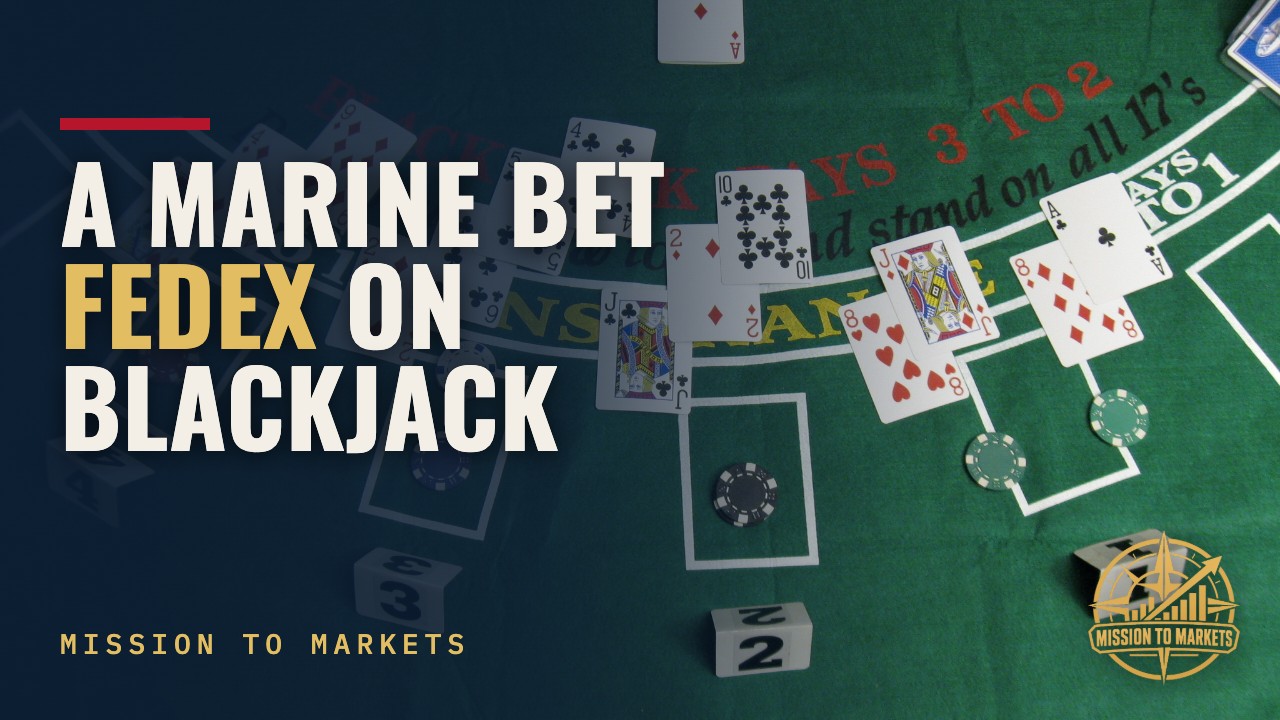
That's when the Las Vegas trip happened. In a book by founding executive Robert Frock, Smith explains that a meeting with the board of General Dynamics, a big defense company he'd hoped would invest, had gone nowhere. He needed money by Monday. He took what was left, about five thousand dollars, to the blackjack tables and came back with twenty-seven thousand. Smith himself put it in perspective later. "The $27,000 wasn't decisive," he said, "but it was an omen that things would get better."
And it got worse. According to a Gale company history, Smith's own investors considered taking the company away from him. His senior officers stood by him. One account, from a summary of Vance Trimble's biography, says they all signed a letter: fire him, and we walk. Smith stayed.
There was a courtroom, too. In 1975, Smith was charged with forging documents involving his family's company to raise money for Federal Express. According to Bloomberg, he went to trial and was acquitted. His sisters also sued him, and Gale's business biography says that suit was settled out of court in 1979.
Now, back to that card table, and let's be fair. Betting the company at a card table is not a strategy. It's a story because it worked, and because the real rescue came after: Smith went back to investors and raised more money. By July 1975, Federal Express turned its first profit. In 1977, after the company lobbied Congress, air cargo was deregulated, which means the government dropped the old rules that kept it flying small planes. Federal Express bought seven Boeing 727s right away. In 1978, it listed on the New York Stock Exchange, meaning anyone could buy a piece of the company.
How It Turned Out
Here's how it turned out. In 1983, according to the company, Federal Express became the first U.S. business to reach one billion dollars in revenue within ten years of startup without buying other companies.
Not every bet paid off. In 1984, FedEx launched ZapMail, a service to zip documents between its offices in a couple of hours. It never made money. A company history from Gale says FedEx shut it down in 1986 and took a three hundred forty million dollar charge, an accounting hit for money it wouldn't get back. Soon, every office had its own fax machine.
The name got shortened to FedEx. Today it averages about seventeen million shipments every business day. "Overnight" became a verb.
Smith ran it for about half a century. He stepped down as CEO in 2022 and stayed on as executive chairman. He died in June 2025, at 80. That October, Captain Frederick W. Smith was laid to rest at Arlington National Cemetery with full military honors.
Three lessons, for you, if you're building something of your own.
One: a good idea still needs the whole system. Smith couldn't fly one plane between two cities and call it a test. Hub and spoke only works when the whole network exists on night one. Sometimes you can't start small. You have to know which kind of business you're in.
Two: the grade doesn't decide it. Whatever that professor wrote on the paper, the idea was right. Get feedback, sure. But don't hand your idea's fate to one reader.
Three: take care of the people carrying the load. Pilots paid for fuel out of their own pockets. Crew sat on their paychecks. That doesn't happen unless people trust the person in charge. Smith learned that leading Marines in a rice paddy, long before he ever led a board meeting.
A captain who came home with two Purple Hearts, and built a company that promises, every single night, to get there by morning. Happy Veterans Day, Captain Smith.
If you served, you already know how to keep a plan alive when it's falling apart around you. Smith did it with jets and payroll. Whatever you're building, that same skill travels.
Tomorrow: two Army Rangers, a flip-flop made from a combat boot, and a deal on Shark Tank. Because the mission didn't end when the uniform came off. New story every weekday. Subscribe so it's waiting for you. This is Mission to Markets, supported by my company, Parcaut Supply Co. I'm Ed Parcaut. Make it a great day.