
EPISODES / EP 09 ·
Two Army Men and a Waffle Iron
Nike · Phil Knight & Bill Bowerman
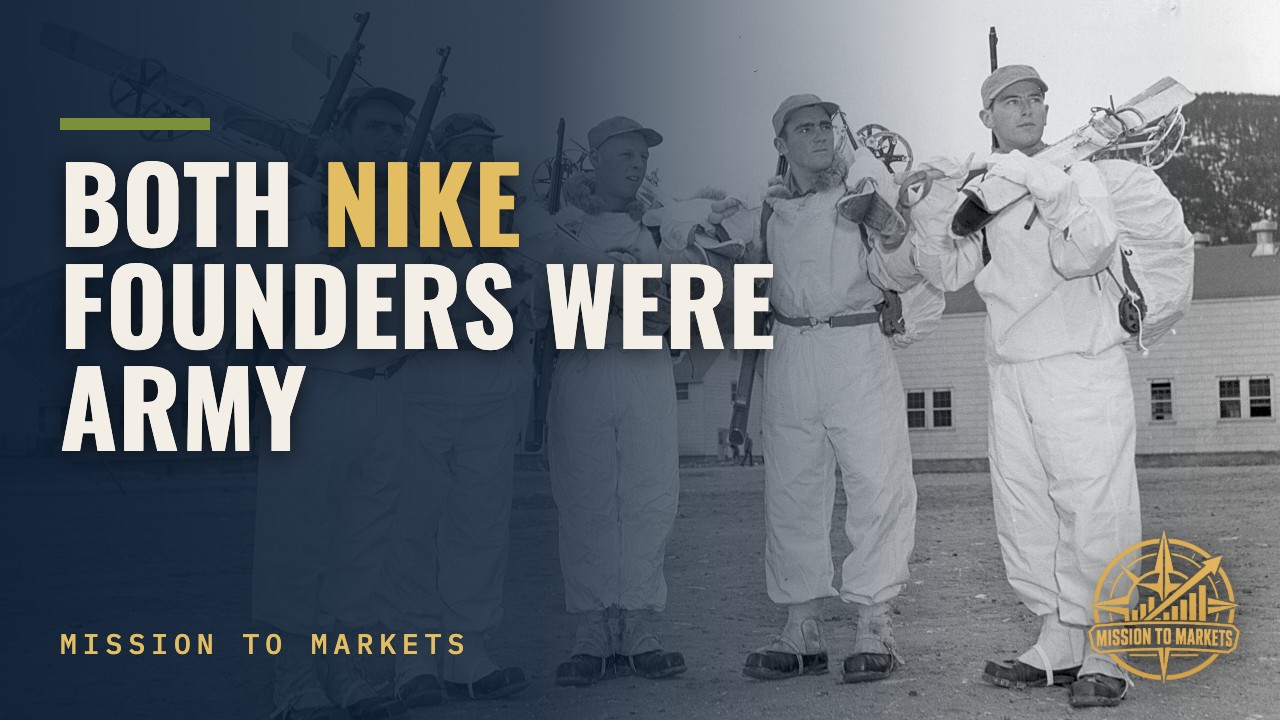
Nike's two founders were both Army men, and one was a 10th Mountain Division major with a Silver Star.
SERVICE U.S. Army (Bowerman: 10th Mountain Division; Knight: Army and Army Reserve)
Out now. About ten minutes.
THE LESSON / ED'S TAKE
Here's my take. If you served, you already know how to keep going when the plan falls apart, and that's what built Nike. Start with what's within reach: the people who've seen you work hard, and the tools already on your kitchen counter.
In this episode
- 0:00Intro
- 1:03Two Army Men
- 2:51Too Heavy, Too German
- 4:17The Handshake and the Waffle Iron
- 6:29The Twenty-Five Million Dollar Bill
- 8:13One Bowerman Drive
Read the full transcript
Spring, 1945. Northern Italy. The war in Europe has days left, and an American officer from Oregon is working out a deal with German forces near the Brenner Pass, the mountain road into Austria. By several accounts, they stand down. He goes home a decorated officer, with a Silver Star among his awards. His name is Bill Bowerman. Fourteen years later, one of his college runners takes an Army commission of his own. That runner is Phil Knight. Together, two Army men start a tiny shoe company on a handshake. Today it's called Nike.
This is Mission to Markets, where every weekday we tell the true story of a company a veteran built. I'm Ed Parcaut. This episode is narrated with an AI version of my own voice, from a script I approved.
Why this show? I'm a Navy veteran who built businesses, and I kept finding out that companies I grew up with were built by people who'd served. Nobody tells you that part. So every weekday, we will.
Two Army Men
Bill Bowerman was a high school teacher and football coach in Medford, Oregon, when Pearl Harbor was attacked in December 1941. Within days, according to both Military.com and a profile from his college fraternity, he joined the Army.
He ended up in the 10th Mountain Division. That was the Army's ski and mountain outfit, trained to fight where trucks and tanks couldn't follow. The University of Oregon's archive of his papers puts him with the division from 1943 to 1945. Oregon Public Broadcasting and We Are The Mighty both say he served as a major. A major is a mid-level officer, often the second-in-command of a battalion of several hundred soldiers.
The division fought up the mountains of northern Italy in early 1945. Bowerman came home with a Silver Star, the Army's third-highest award for valor in combat, plus four Bronze Stars. And in the war's last days, several accounts credit him with negotiating that stand-down of German troops near the Brenner Pass.
Then he went back to coaching at Medford High. In 1948, the University of Oregon hired him. He'd stay twenty-four years, win four national team titles in track, and coach thirty-three Olympians, according to the university's archive.
Phil Knight was one of his runners in the late 1950s, a middle-distance man. When Knight graduated from Oregon in 1959, he took an Army commission. Military.com and We Are The Mighty both report one year of active duty, then seven years in the Army Reserve.
His service was quieter than his coach's. No combat. But do the math on those dates. Knight was still a reservist when the shoe company got off the ground. Both founders of Nike wore the uniform. One of them was still wearing it, part-time, while the company was born.
Too Heavy, Too German
Bowerman's problem was weight. Oregon Public Broadcasting says he saw heavy gear as a drag on his runners, so he did something most coaches never would. He took lessons from a local shoemaker and started building custom shoes for his athletes by hand. He even filmed them with an old Army camera to study their form.
Knight's problem was different. After his year in the Army, he went to Stanford's business school. In his memoir, Shoe Dog, Knight describes a paper he wrote there. Here's the idea, in plain terms. Japanese cameras had taken a big bite out of a market German companies used to own. Knight argued Japanese running shoes could do the same thing to the German shoe brands that ruled the track.
In 1962, Knight traveled to Japan. In Kobe, according to Military.com, he found Tiger running shoes made by a company called Onitsuka, which today is known as ASICS. He liked them. And he got the rights to sell them in the western United States.
No company. No product. No crew. Just a young reservist with a school paper, asking a Japanese manufacturer for a territory.
Then he came home and waited. Military.com says he worked as an accountant while the sample shoes made their way across the Pacific. When they finally showed up, he did the most natural thing in the world for a former Oregon runner. He mailed a pair to his old coach.
The Handshake and the Waffle Iron
Bowerman didn't just like the shoes. He wanted in. And he wanted to make them better.
In 1964, the two of them started Blue Ribbon Sports. A profile from Bowerman's fraternity describes it as a handshake agreement. On the money, the accounts differ. One business reference says each man put in five hundred dollars. Military.com says the company started with twelve hundred dollars in the bank. Either way, it was pocket change.
Blue Ribbon was a distributor: it bought shoes from Onitsuka and resold them to American runners.
But Bowerman kept tinkering, and Onitsuka kept listening. NPR reports that in 1967, Onitsuka sent a new prototype and asked for a name. Bowerman suggested "Aztec," for the 1968 Mexico City Olympics. Adidas already had a shoe with a similar name and threatened to sue. So, per Knight's memoir, they went with "Cortez" instead. It sold so well they couldn't keep it in stock.
Then came the waffle iron. Oregon Public Broadcasting and the university's archive both tell it the same way. Bowerman took his wife's waffle iron, added a little urethane, a kind of liquid rubber, and made a sole with little grippy squares. It held a track without metal spikes. It became the Waffle Trainer.
Meanwhile, the partnership with Onitsuka was coming apart. According to a business history in Encyclopedia.com, Onitsuka demanded a majority stake in Blue Ribbon and threatened to pull the deal. Knight and Bowerman said no and found other factories.
It didn't end with a handshake. It ended in court. Onitsuka and Blue Ribbon sued each other, and both wanted the Cortez name. According to Sneaker Freaker, Blue Ribbon won in 1974. NPR reports Nike kept the name, and Onitsuka renamed its version the Corsair.
Going it alone meant they needed their own name and their own mark. The name was Nike, the Greek goddess of victory. The mark came from Carolyn Davidson, a design student at Portland State University, where Knight was teaching accounting. According to the university and ESPN, she was paid thirty-five dollars for the swoosh.
The Twenty-Five Million Dollar Bill
Here's what almost ended it.
In the late 1970s, the U.S. government hit Nike with a bill for about twenty-five million dollars in back import duties. Complex and Fox News, citing Knight's own account, describe how it worked. A tariff rule from 1922 let customs charge duty based on the price of a similar American-made shoe, not what the import actually cost. For a company that bought its shoes overseas, that was a crushing number.
So Nike got creative. It quietly made a cheap nylon running shoe called the One Line, sold under a different name, with no swoosh. The point was to give customs a new, low-priced American shoe to compare against. According to those same reports, the two sides settled at nine million dollars. Knight wanted it done before Nike's next big step, selling stock to the public.
That wasn't the only scare. A University of Maryland review of Shoe Dog puts it this way: under a less committed leader, the company "likely would have folded half a dozen times in its first decade."
Success brought trouble, too. By 1987, according to Encyclopedia.com, Reebok's sales had passed Nike's.
There's a harder chapter, too, and it deserves a fair hearing. In the 1990s, critics accused Nike of poor pay and conditions at the overseas factories that made its shoes. In 1998, Knight stood up at the National Press Club and promised reforms, including higher minimum ages for factory workers and outside monitoring. Three years later, a watchdog group called Global Exchange said Nike had fallen short, sometimes far short. Knight pushed back. The Seattle Times quoted him: "I think we've made significant strides."
One Bowerman Drive
So how did it turn out?
Nike went public in 1980. That's an IPO, an initial public offering, when a company first sells shares of itself to anyone who wants to buy them. The review in Maryland notes that Knight's net worth hit one hundred seventy-eight million dollars overnight.
In its 2025 fiscal year, Nike reported forty-six point three billion dollars in revenue. That was down ten percent from the year before. Even giants have bad stretches. Its world headquarters sits in Beaverton, Oregon, at an address called One Bowerman Drive.
Bowerman died in 1999. Knight ran Nike until 2004 and stayed chairman until 2015, according to Military.com.
Three lessons, and then I'll let you go.
One. Your best partner might be someone who's already seen you work hard. Knight didn't pitch a stranger. He mailed shoes to the man who'd coached him. If you're building something, look at the people who've already watched you sweat.
Two. Use what's in your kitchen. Bowerman didn't wait for a lab. He used a shoemaker's lessons, an old Army camera, and his wife's waffle iron. You probably have more tools in reach than you think.
Three. When the rules stack up against you, get creative and stay legal. That twenty-five million dollar bill could have sunk them. Instead, they changed the comparison. Find the honest angle nobody else is looking for.
Here's my take. If you served, you already know how to keep going when the plan falls apart, and that's what built Nike. Start with what's within reach: the people who've seen you work hard, and the tools already on your kitchen counter.
Tomorrow: an Army mess sergeant who learned to feed two thousand soldiers a day, then built Wendy's. Because the mission didn't end when the uniform came off. New story every weekday. Subscribe so it's waiting for you. This is Mission to Markets, supported by my company, Parcaut Supply Co. I'm Ed Parcaut. Make it a great day.