
EPISODES / EP 12 ·
Ten Stools
Chick-fil-A · Truett Cathy
A World War II Army veteran from Georgia opened a ten-stool, all-night diner in 1946, closed it on Sundays, and turned a boneless chicken sandwich into Chick-fil-A.
SERVICE U.S. Army
Out now. About ten minutes.
THE LESSON / ED'S TAKE
If you're getting out and thinking about a place of your own, you don't need a big idea. You need a spot where people are already hungry, and a rule you'll keep even when it costs you.
In this episode
- 0:00Intro
- 1:02The Service
- 2:30The Problem
- 3:22The Plan
- 4:43The Hard Years
- 7:22How It Turned Out
Read the full transcript
On May 23rd, 1946, two brothers opened the door of a diner so small they named it after a dwarf. Ten stools. Four tables. Open all night. The first day's take was fifty-eight dollars and twenty cents. Three years later, both of the brothers who were supposed to run it with him were gone, killed in the same plane crash. The one who was left was a quiet Army veteran from Georgia. He kept the grill hot. And today, on Thanksgiving, you'll find his restaurants doing the one thing he insisted on from the start. They're closed.
This is Mission to Markets, where every weekday we tell the true story of a company a veteran built. I'm Ed Parcaut. This episode is narrated with an AI version of my own voice, from a script I approved.
Why this show? I'm a Navy veteran who built businesses, and I kept finding out that companies I grew up with were built by people who'd served. Nobody tells you that part. So every weekday, we will.
The Service
Samuel Truett Cathy was born on March 14th, 1921, in Eatonton, Georgia. The Great Depression hit his family hard. His mother rented a house and took in boarders to keep everyone fed, and young Truett pitched in by selling Coca-Cola and running a paper route, according to the New Georgia Encyclopedia. He learned early that food and hard work paid the rent.
Then the war came, and Truett went into the U.S. Army. Here's where I have to be straight with you. The sources don't agree on his dates. The Atlanta Journal-Constitution's timeline says he was drafted in 1939, but the peacetime draft didn't begin until late 1940, so that date is doubtful. A profile in Philanthropy magazine says 1941. One company history says he was discharged in 1944, while the Journal-Constitution says 1945. So we'll say what everyone agrees on: he served in the Army during World War II.
What did he do? Not what you'd picture. He wasn't storming beaches. A company history published by encyclopedia.com says he had relatively easy duty as a clerk, and never got farther from home than Fort Lewis, Washington. A clerk handles the paperwork that keeps an army moving: records, orders, supplies. Not glamorous. But every unit runs on it.
His brother Ben served overseas. Ben fought in Europe, that same company history says. Both brothers made it home. And they came home with a plan.
The Problem
The problem the Cathy brothers saw was simple. Hungry people, working odd hours, with nowhere to eat.
After the war, a new Ford assembly plant was going up in Hapeville, a small town just south of Atlanta, right by the airport. According to the Horatio Alger Association, the brothers bought land near that new plant. Plants and airports run shifts. People get off work at strange hours, and they want a hot meal and a cup of coffee when they do.
So the brothers decided to build a diner that never closed. Well, almost never. We'll get to that.
They didn't have much to work with. Truett sold his car. The brothers pooled about four thousand dollars of savings and came up with another sixty-six hundred, according to the Horatio Alger Association. That was the whole war chest. And they spent it on a place small enough that the name came with it: the Dwarf Grill.
The Plan
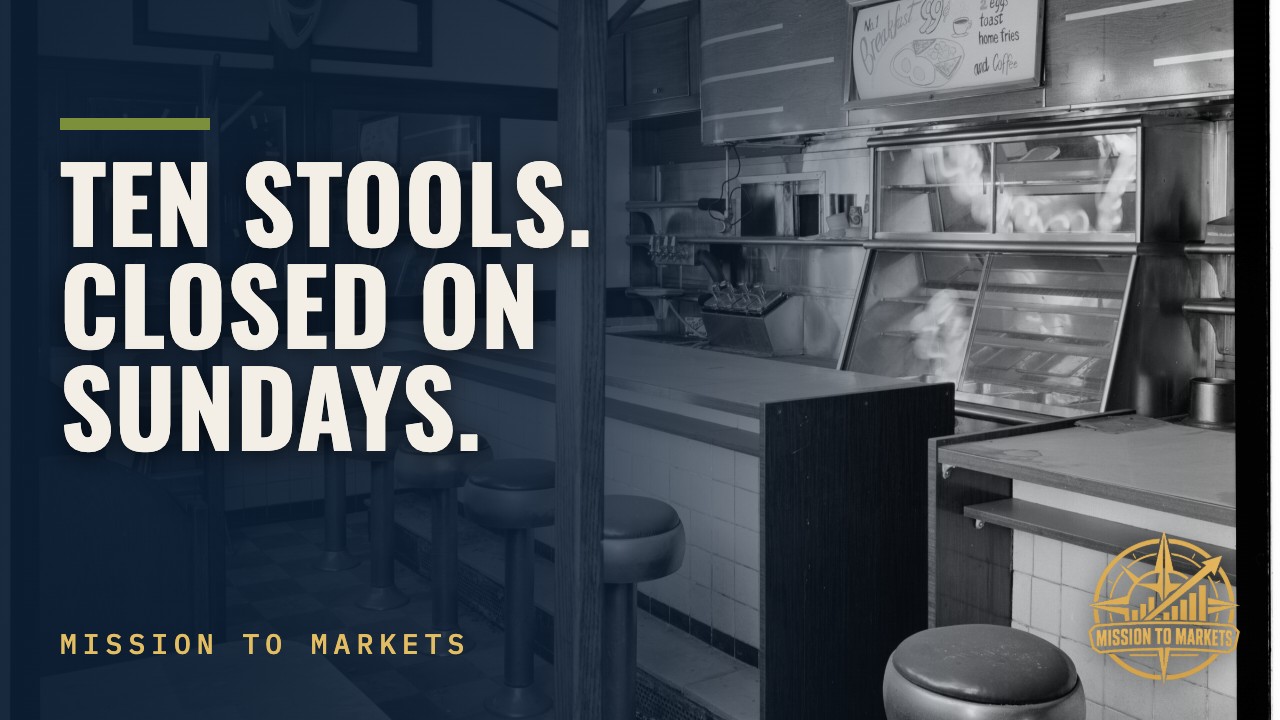
The Dwarf Grill opened on May 23rd, 1946, at 461 South Central Avenue in Hapeville. Ten counter stools and four tables. Open twenty-four hours. Its first customers were mostly workers from the Ford plant and the airport.
Then Truett made the decision that still defines his company. He'd worked seven-day weeks in restaurants, and he decided they would close on Sundays. The company says the choice was made in 1946, so the crew could rest and worship. His Southern Baptist faith was part of it, the Horatio Alger Association says. But he also gave a plainer answer, quoted in that company history: "we were just tired!"
Think about that as a business call. A twenty-four-hour diner that shuts down for an entire day, every week, by choice. Most owners would call that leaving money on the table. Truett called it the price of keeping his people.
Then came 1949. Ben and another brother, Horace, were killed in a plane crash. Truett was left to run the business alone. That same year, he married Jeannette McNeill. They'd be married sixty-five years.
He kept going. In 1951 he opened a second restaurant in nearby Forest Park. He later told the Horatio Alger Association, "With two restaurants, if I wasn't having problems in one, I was having problems in the other."
The Hard Years
In 1960, a fire destroyed the Forest Park restaurant. According to that encyclopedia.com company history, his insurance wasn't enough to rebuild. So he put ninety thousand dollars on the line and opened a new restaurant there, built around a new concept. His customers didn't love it. They wanted the old Dwarf House. So he went back to what worked in Hapeville.
That's the low point. A fire, a big bet, and a new idea that flopped. But in the middle of all that, he found the sandwich.
In 1961, according to the Associated Press, a supplier that made boneless, skinless chicken for airline meals offered him pieces that were too big for its airline customers. Truett started experimenting. He put a boneless breast on a buttered bun, which kept the grease off customers' fingers. He settled on a pressure cooker, a sealed pot that cooks fast under steam pressure, with peanut oil. Then he added a pickle. That was it.
He needed a name. He trademarked "Chick-fil-A" in 1963. The company history says the "A" was meant to suggest the best, like a top grade.
At first he sold the sandwich to other restaurants. Then in 1967, he opened the first Chick-fil-A restaurant at Greenbriar Mall in Atlanta, described in that company history as the first indoor mall in the Southeast. Malls became the chain's home for years. The Journal-Constitution says the first free-standing Chick-fil-A didn't open until 1986.
He also built an unusual model. Chick-fil-A doesn't franchise in the usual way. A franchise is when a company lets an owner use its name and recipes in exchange for an investment and a cut. For years, Chick-fil-A picked its operators and asked them to put in just five thousand dollars, then split the profits, according to that company history. He wanted owner-operators who'd show up, not investors who wouldn't.
Even with all that, it wasn't a straight line up. The same history says early coupon promotions lost a lot of money. By 1982, other chains were selling chicken sandwiches too. The New Georgia Encyclopedia says Chick-fil-A's sales dropped while chicken got more expensive, right after it built a new headquarters. Cathy's team sat down and wrote out a corporate purpose. They also added chicken nuggets. The encyclopedia says sales rose thirty-six percent the next year. The company history we mentioned puts the jump higher, at more than forty percent within six months.
Also in 1982, the Journal-Constitution reports, a mall developer offered to give five thousand dollars to a church of his choice for every mall restaurant he opened on Sundays. He said no.
How It Turned Out
Truett Cathy died on September 8th, 2014. He was ninety-three. By then Chick-fil-A had more than eighteen hundred restaurants, and the Associated Press reported annual sales topping five billion dollars. In 2012, the Journal-Constitution says, it passed KFC to become the number one chicken chain in U.S. sales. Today, industry counts put it at more than three thousand restaurants.
The company's growth hasn't come without criticism. In 2012, comments by his son Dan about same-sex marriage, along with the company's donations, set off boycotts, as the Associated Press reported. Truett's own giving went largely to foster children and other young people. The New Georgia Encyclopedia says he and his wife took in more than one hundred fifty foster children.
Three lessons for you.
First, start where the customer already is. The Cathy brothers didn't invent a market. They put a diner next to a plant full of people working the night shift.
Second, decide what you won't do, and mean it. Closing on Sundays meant giving up a day of sales every week for sixty-eight years. It also gave his crew a reason to stay. His executives liked to say, the AP reported, that they earned in six days what competitors earned in seven. You don't have to agree with his reasons to see that a clear rule, kept for decades, builds trust.
Third, the low point is often where the next idea shows up. He found his sandwich in the years right after a fire and a failed restaurant. If he'd quit after Forest Park, there's no Chick-fil-A.
Here's my take. A company clerk, which is how one history describes his Army job, doesn't get a medal for what he does. He gets the paperwork right, every day, so the people around him can do their jobs. Truett Cathy ran his restaurants the same way. Show up. Do the small thing right. Then do it again tomorrow. And on this Thanksgiving, with his doors locked so his crew can be home, that's not a bad legacy for a man who started with ten stools.
If you're getting out and thinking about a place of your own, you don't need a big idea. You need a spot where people are already hungry, and a rule you'll keep even when it costs you.
Tomorrow: a color-blind Navy radioman, a homemade salad dressing, and a company that gives away every dollar of profit. Because the mission didn't end when the uniform came off. New story every weekday. Subscribe so it's waiting for you. This is Mission to Markets, supported by my company, Parcaut Supply Co. I'm Ed Parcaut. Make it a great day.